
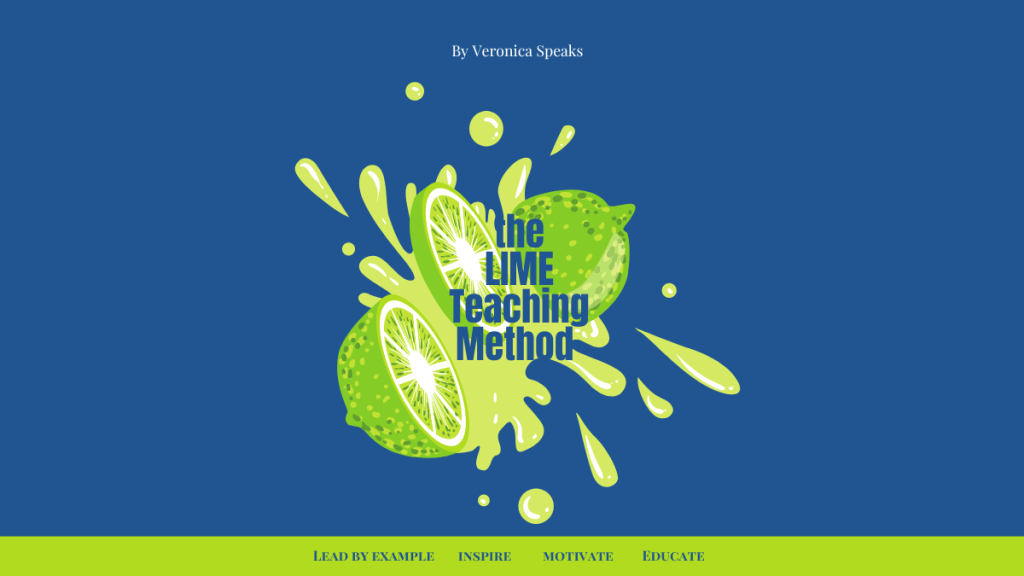
Let’s use the LIME Teaching Method
The LIME Teaching Method is built on the foundational understanding that students deserve teachers that model the growth mindset behaviors. If we student learning to stick, we must show them what it looks like.
The LIME Teaching Method Basics: What does LIME stand for?
LIME is an acronym for Lead by Example, Inspire, Motivate, and Educate. This acronym is directing and memorable.
The LIME Teaching Method is a process of Leading by Example to Inspire, Motivate, and Educate students to be lifelong learners and critical thinkers.
The ability to learn and think creatively allows for students to grow their freedoms and experience the wealth of knowledge.
Check out this article: Success Looks Like Me, Too.
As an educator, I learned we must lead by example and model the behavior we want our students to learn. Becoming their role model is much more than just giving them directions, they must see that we uphold and follow those same directions.
“Monkey see, monkey do,” is an American idiom I keep readily available in my toolbox of knowledge.
This idiom is interpreted to reveal that children tend to imitate or copy what they see adults and other children doing.
What a child constantly sees is what they repeat.
Use The LIME Teaching Method Now!
The childlike mind is a sponge. The experience of their childhood environment provide the foundation on how they interact with the world for the rest of their life.
The ages 0-7 directly influences how a child experiences any time after 7 years of age. Studies reveal that the origins of inequalities and disorders are rooted in a child’s first years of life.
Below is an excerpt from an article supporting this claim:
Accelerated processes of brain development and maturation
Fatori et. al, 2018, p.1
occur during the first years of life and lead to the initial
structuring of cognitive and emotional functions. Due to the
intense brain plasticity at this time of life, environmental
stimuli can direct substantial changes in functioning and
also in the structure of the developing brain, in a positive
or negative way [1]. In fact, clinical and epidemiological
evidence indicates that the origins of educational, social and
economic inequalities and chronic diseases, including men-
tal disorders, go back to the first years of life [2]. Despite the
relevance of the first years of life for the success of families,
communities and nations is very well established, it is esti-
mated that in 2017, there were approximately 150 million
stunted children under 5 globally [3]. Children are also dis-
proportionately represented among the extreme poor, repre-
senting 46% of the population living on less than US$1.90
per day around the world [4]. Poverty and malnutrition, as
well as exposure to family and community stress and vio-
lence, negligence, abuse and maltreatment, restricted access
to learning experiences and to health care, are important
barriers to full development and are associated to various
life-long negative health, educational and social outcomes
[5] generating an unfavorable economic impact on the devel-
opment of nations [6].
I’ve always wanted to grow ‘Whole’ children
Children grow on to be adults in this world, so it’s important we take care of them and provide them to tools necessary to be healthy and well-rounded individuals.
I wanted to be a pediatrician from 5 years old to 20 years old when I realized I don’t need to be a doctor to mentor and help children life their best life.
I answered the calling as an educator and I’m not looking back. Being in the Master’s of Education program at Concordia University Chicago equips me with the ability to build a curriculum that uses assessment to evaluate the effectiveness of educational systems and it’s ability to support student learning.
My educational philosophy extends from philosopher John Dewey’s whole student-centered education.
To be awake is to be alive (Dewey, 2013, p. 218). There are different degrees of being aware and it determines the capability of the human mind and interaction with the outside world.
Understanding this awareness, or wide-awakeness, allows me to further embrace the idea of holistic health and student-centered education.
As a educator, I am a guide not a dictator in the classroom. My purpose is to show students that I am human and I am not just “playing a role”. It is far too easy for teachers, like other people, to play their roles and do their jobs without serious consideration of the good and right (Dewey, 2013, p. 220).
Embracing our humanity in this current reality encourages students to do the
same. When we collectively live in the present moment and discuss the experience of Now, it prepares us to be conscious and have an attitude of full attention to life and its requirement (Dewey, 2013, p.218).
For the rest of my life, I vow to Lead by Example to Inspire, Motivate, and Educate every student who crosses my path just one convo at a time.
With peace,
Veronica Speaks


 Veronica Speaks
Leave a comment